
Silence is often misunderstood as avoidance or emotional weakness. Psychologically, however, silence is frequently a learned coping strategy, one developed in environments where vulnerability was unsafe, misunderstood, or punished.
Drowning in Silence explores silence not as a failure to speak, but as a survival response. Many individuals learn early that expressing pain leads to dismissal, shame, or further harm. Over time, silence becomes adaptive: it reduces conflict, preserves relationships, and protects the individual from perceived rejection.
What begins as protection, however, can slowly become a prison.
- Silence as Emotional Self-Protection
Pause for a moment and imagine this scenario:
You finally share something difficult to say, your sadness, your fear, your exhaustion, and the response you receive is “You’re overreacting,” “Others have it worse,” or “You should be grateful.”
Now notice what happens inside you. Your body tightens. You pull back. You quietly decide, “I won’t do that again.”
From a psychological perspective, silence functions similarly to other defensive mechanisms. When emotional expression is met with negative outcomes, the nervous system learns to suppress rather than disclose. This is particularly common among:
- individuals raised in emotionally invalidating environments,
- high-achieving or “strong” personalities,
- caregivers and leaders,
- those exposed to trauma or chronic stress.
In these cases, silence is not a lack of awareness; it is emotional containment. The individual is often deeply aware of their pain but has learned that holding it in feels safer than letting it out. Silence becomes a way to survive.
- The Cost of Long-Term Emotional Suppression
Now imagine carrying that silence not for days or months, but for years.
You show up. You perform. You function. On the outside, life looks intact. On the inside, however, something feels increasingly heavy, dull, or disconnected.
While silence may provide short-term relief, long-term emotional suppression carries high psychological costs. Research consistently links emotional inhibition to increased anxiety, depression, somatic symptoms, and dissociation. The body continues to carry what the voice does not release.
Drowning in Silence illustrates this internal conflict clearly: individuals may appear functional, productive, and emotionally stable while privately experiencing exhaustion, emotional numbness, or despair. This split between outward presentation and inner experience creates psychological strain that cannot be sustained indefinitely.
Eventually, the system fatigues, not because the person is weak, but because no one was meant to carry pain alone.

- Why Silence Feels Safer Than Speaking
Take a moment to ask yourself honestly:
When was the last time I wanted to say something but didn’t it?
Many individuals report that silence feels safer than disclosure because:
- They fear being perceived as weak.
- They fear burdening others.
- They fear spiritual or moral judgment.
- They fear being misunderstood or minimized.
Psychologically, these fears are not irrational. They are rooted in lived experience. Silence preserves predictability and reduces the risk of rejection, disappointment, or conflict.
Drowning in Silence validates these fears while gently challenging the belief that silence is the only option. The book does not rush readers toward disclosure; it helps them understand why silence became necessary in the first place.
- Reframing Silence as a Signal, Not an Identity
Pause here and reflect:
Do you describe yourself as “private,” “low-maintenance,” or “just not emotional”?
A key contribution of Drowning in Silence is its reframing of silence. Silence is not portrayed as identity (“this is who I am”) but as information (“this is what I learned to do”). This distinction is critical for healing.
When silence is understood as a response rather than a trait, individuals can begin to explore alternatives at a pace that feels safe. Speaking is no longer forced; it becomes an invitation.
Silence may have protected you once, but it need not define you.
- Psychological Healing Begins With Safety
The book emphasizes a core psychological truth: people do not speak because they are told to speak; they speak because they feel safe.
Emotional healing does not begin with disclosure. It begins with safety, presence, and validation. Drowning in Silence honors silence while gently inviting voice, modeling an approach consistent with trauma-informed care.
It reminds readers that silence may once have protected them, but they no longer need to drown in it.
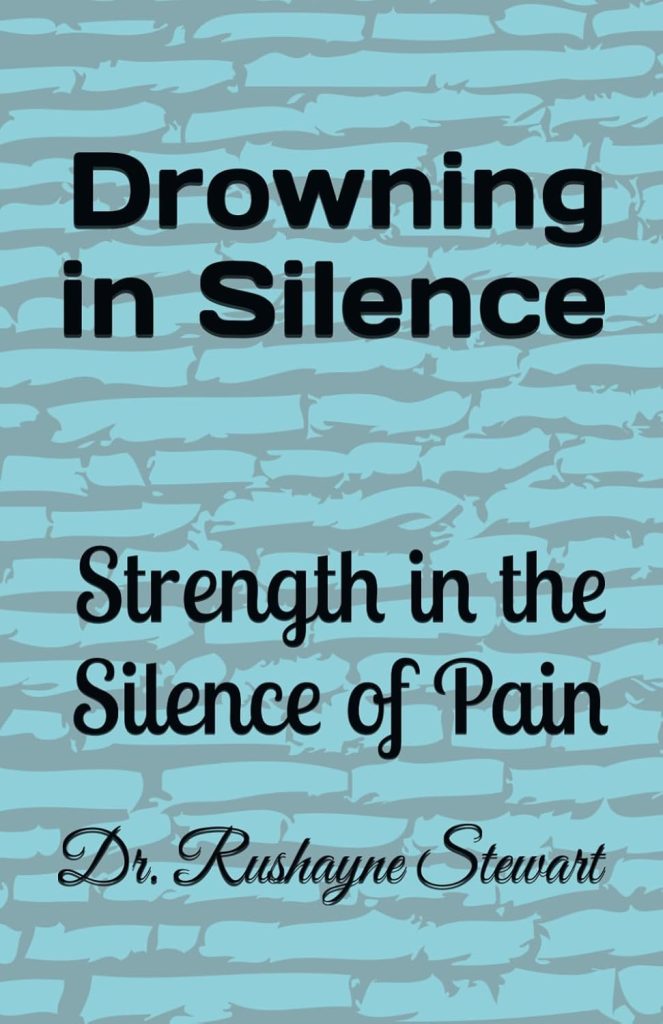
If you’ve ever felt weighed down by emotions you couldn’t name, or struggled in silence while smiling in public, Drowning in Silence: Strength in the Silence of Pain by Dr. Rushayne Stewart offers the compassionate understanding you’ve been searching for. This powerful book combines deep psychological insight with gentle, faith-informed guidance to help you move from hidden suffering toward honest healing, without judgment or spiritual condemnation. Whether you’re wrestling with anxiety, grief, self-doubt, or the fear that asking for help makes you weak, Dr. Stewart’s work speaks directly to your experience and affirms your worth in every chapter. You can find Drowning in Silence on Amazon here: Drowning in Silence: Strength in the Silence of Pain on Amazon — a resource that could be the beginning of renewal for you or someone you care about.